Key Takeaways
- Getting found in ChatGPT and Google AI is built on the same fundamentals as traditional SEO, not a separate ranking system.
- Google has confirmed that crawlability, useful original content, and clean technical structure matter more than any AI-only trick.
- ChatGPT search visibility depends on allowing OAI-SearchBot, which is a separate control from blocking GPTBot for AI training.
- No special file or schema, including llms.txt, is required to appear in generative AI search results.
- A practical checklist covering crawl access, content clarity, and structured data gives you real control over your AI search presence.
Introduction
A business gets found in ChatGPT and Google AI the same way it gets found in traditional search: by being crawlable, indexable, and genuinely useful. There is no separate ranking system to game. Google has said directly that optimizing for generative AI search is optimizing for the overall search experience, meaning it falls under standard SEO. ChatGPT search works differently under the hood, but the same principle holds. If your content is accessible to the right crawlers, technically sound, and written to actually answer questions, you are doing the work that matters. The rest of this guide breaks down what you can control, what you cannot, and what to ignore.
AI Search Optimization Is Still SEO, Not a New Discipline
Google has been explicit about this. Gary Illyes and Cherry Prommawin told Search Central Live attendees that GEO and AEO, meaning generative engine optimization and answer engine optimization, do not require separate frameworks from standard SEO. Google's own documentation, published in a new Generative AI fundamentals section, frames optimizing for AI features as an extension of optimizing for search itself.
This matters because a lot of noise in the industry suggests you need entirely new tactics to show up in ChatGPT or Google's AI Overviews. That framing sells consulting hours and toolkits, but it does not match what the platforms themselves are saying. If your site already follows solid SEO practice, you already have a foundation for AI search visibility.
The practical shift is less about new tactics and more about tightening things many businesses have let slide: crawl access, content depth, and structural clarity. Those are the levers that actually move the needle.
Want help implementing this in your business?
Book a CallWhat Google Has Confirmed About Ranking in AI Overviews
Google's guide states plainly that creating content people find unique, compelling, and useful will likely influence a website's presence in generative AI search more than any other single suggestion in the guide. That is Google's own language, and it puts content quality ahead of every technical tweak.
Beyond content, Google points to the same technical foundations that have always mattered: image and video SEO best practices, structured data that matches what is visibly on the page, and clean crawlability. If you are already following those practices, Google says you are already optimizing for generative AI search. There is no separate checklist waiting to be unlocked.
Google also addresses a tempting but risky tactic: building separate pages for every possible phrasing of a question, sometimes called fan-out queries. Google cautions against creating this kind of content primarily to manipulate rankings rather than to genuinely serve a subtopic. Deep, natural topical coverage beats a pile of near-duplicate pages targeting keyword variants.
How ChatGPT Search Decides What to Show
ChatGPT search works on its own infrastructure, but the eligibility rule is simple. Any public website can appear in ChatGPT search results. To be discovered, surfaced, and properly cited and linked, publishers need to make sure they are not blocking OAI-SearchBot, which sometimes means updating a robots.txt file.
There is an important distinction between two different crawlers. A business can allow OAI-SearchBot to appear in ChatGPT search results while still disallowing GPTBot, which signals that crawled content should not be used to train OpenAI's underlying models. These are two separate controls, and many sites now configure them differently on purpose: visible in search, opted out of training data.
One nuance worth knowing: blocking OAI-SearchBot does not guarantee total removal from every ChatGPT surface. If OpenAI obtains a page's URL from a third-party search provider or by crawling other pages, and has signals the page is relevant, it may still surface just the link and title in ChatGPT Atlas. Businesses that want complete removal need to use a noindex meta tag instead of relying on robots.txt alone.
Once you're set up correctly, publishers can track referral traffic from ChatGPT using standard analytics platforms like Google Analytics, which gives you a way to measure whether this channel is actually sending visitors.
What You Can Control Versus What You Cannot
It helps to separate the levers you actually have from outcomes you cannot promise yourself. You can control whether crawlers are allowed access, whether your content answers questions clearly, whether your structured data is accurate, and whether your internal linking shows topical depth. You cannot control whether a specific AI system chooses to cite you, how it summarizes your content, or whether it sends a click at all.
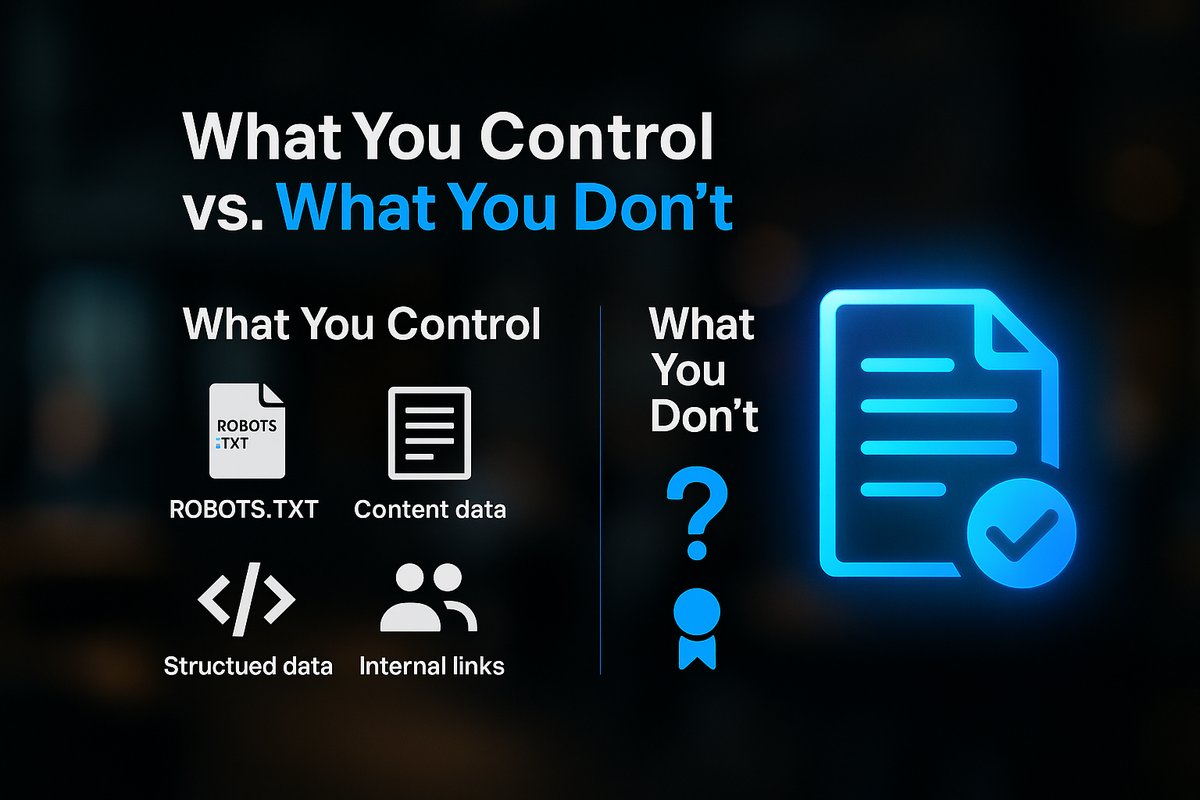
This distinction matters for setting expectations internally. An AI search optimization effort is not a guarantee of citations or rankings. It is a set of controllable inputs that improve your odds of being the source an AI system pulls from when it does decide to cite something. Anyone promising guaranteed placement in ChatGPT or Google AI Overviews is overselling what any business can control.
Mythbusting: Tactics You Can Skip
Google's updated guidance includes a section specifically built to bust myths, and it names several tactics as unnecessary. This is worth paying attention to because it comes directly from Google, not from third-party speculation.
Google states that llms.txt files are not required. There is no special machine-readable file you need to create just for AI crawlers to understand your site. Content chunking purely for AI consumption is also called out as unnecessary, along with inauthentic mentions designed to manufacture the appearance of authority. Google is also explicit that AEO and GEO, as separately branded disciplines, are not required frameworks.
If you see a vendor pitching a proprietary llms.txt generator or a special AI-only schema package as essential for visibility, treat that claim with real skepticism. It is not confirmed by the platforms themselves, and in some cases it is directly contradicted by their own documentation.
The AI Search Optimization Checklist
Here is a practical starting checklist based on confirmed platform guidance rather than speculation. Work through it in order, since crawl access has to be right before anything else matters.
Check that OAI-SearchBot is not blocked in your robots.txt if you want ChatGPT search visibility, and decide separately whether to allow or disallow GPTBot for training purposes. Confirm your site is fully crawlable and indexable by Google, since generative AI features draw from the same index as traditional search. Audit your structured data to make sure it accurately matches what is visibly on the page, since mismatched schema can create trust problems. Write content that directly and clearly answers real questions your customers ask, in self-contained passages that make sense on their own. Build internal links between related pages so search systems and AI crawlers understand your topical coverage. Follow existing image and video SEO practices rather than treating them as a separate AI task. Skip llms.txt, content chunking schemes, and inauthentic mention campaigns unless new confirmed guidance changes this.
None of these steps guarantee a citation in ChatGPT or an appearance in an AI Overview. They give you the strongest possible foundation for being the kind of source these systems are built to pull from.
Conclusion
Getting found in ChatGPT and Google AI comes down to the same fundamentals that have always mattered in search: crawlability, useful content, and a clean technical foundation. Google has confirmed this directly, and ChatGPT's own crawler rules follow a similar logic. There is no secret ranking system, no required special file, and no guarantee that any single tactic earns you a citation. What you can do is control the inputs: crawler access, content clarity, accurate structured data, and topical depth through internal linking.
If you are not sure where your site currently stands on any of these fronts, that is worth finding out before guessing at fixes. Request an AI Search Visibility Audit from TitanTech360 and get a clear picture of what is helping or hurting your presence in ChatGPT and Google AI, based on what these platforms have actually confirmed matters.
Frequently Asked Questions
Ready to Put This Into Practice?
Let's talk about where your business stands today and what to fix first.
Book a Call