

Key Takeaways
- Topical authority SEO means becoming the go-to resource for a specific subject, not just targeting scattered keywords.
- Start with a narrow, well-defined topic that aligns with your business goals and customer needs.
- Map the important questions within a useful topic boundary, then create a structured cluster: one pillar page plus distinct supporting content.
- Internally link your cluster pages on purpose—show search engines and users how your content fits together.
- Show real expertise, keep the cluster up to date, and finish one topic thoroughly before chasing others.
Introduction
Building topical authority for SEO means your business is seen as the expert in a specific subject—by both users and search engines. You earn this by covering every important aspect of a topic, not just by writing lots of keyword articles. To build topical authority, define a tight topic boundary, map out subtopics and the questions your audience actually asks, create a main pillar page and detailed support pages, connect them with deliberate internal links, and keep everything up to date and based in real expertise. This guide walks you through each step—using practical, repeatable methods TitanTech360 applies for its own service clusters and client strategies.
What Is Topical Authority in SEO?
Topical authority means becoming the go-to resource on a well-defined subject, not just hitting individual keywords. Search engines reward sites that demonstrate depth, breadth, and genuine experience across an entire topic cluster. For example, ranking well for lots of terms related to 'SEO for small business'—not just the phrase itself—shows topical authority.
It’s not a hidden score or metric, but a strategy: you show search engines and users your expertise by fully answering real questions and connecting all related subtopics in a meaningful way. Coherent topic coverage helps readers find related answers. It does not guarantee rankings, AI citations or protection from algorithm changes.
For more foundational context on SEO, see our guide: What Is SEO and How Does It Work for Small Businesses?.
Want help implementing this in your business?
Book a CallStep 1: Define a Clear Topic Boundary
Start by deciding exactly what you want your site (or section) to be known for. Choose a topic core that matches your business goals and what your customers truly value. This is your chance to be specific: 'AI integration for small business' is stronger than just 'AI.'
Your chosen topic should be narrow enough to cover fully, but substantial enough to support in-depth content. Equally important—set limits on what your topic does NOT include. This focus helps prevent thin, scattered content that undermines authority.
Step 2: Map Every Subtopic and User Question
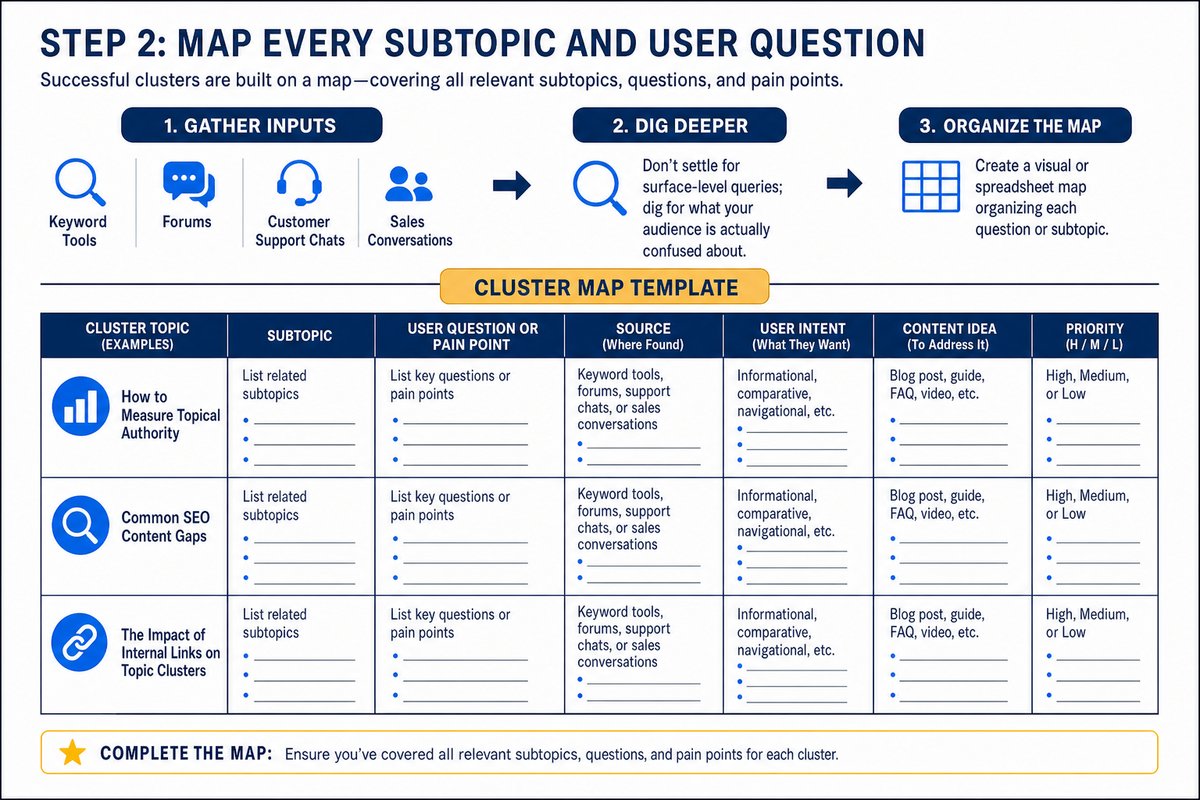
Successful clusters are built on a map—covering all relevant subtopics, questions, and pain points. Gather these from keyword tools, forums, customer support chats, and real-life sales conversations. Don’t settle for surface-level queries; dig for what your audience is actually confused about.
Create a visual or spreadsheet map organizing each question or subtopic. Common clusters might include 'how to measure topical authority,' 'common SEO content gaps,' or 'the impact of internal links on topic clusters.'
Step 3: Build a Structured Content Cluster
Next, create your cluster. The centerpiece is a pillar page—a broad, well-structured resource on your main topic. Around it, develop supporting pages, each focused on a specific subtopic or frequent user question. Every supporting page links back to your pillar and to relevant siblings in the cluster, creating clear relationships for readers and search engines alike.
The goal is not to flood your site with content, but to provide thorough, non-overlapping coverage of the topic. Prioritize the questions most useful to customers and maintain the cluster over time. There is no required number of supporting articles.
For a look at practical content clusters and SEO structures, see: SEO Guides for WordPress and Growing Businesses.
Step 4: Demonstrate Real Expertise and First-Hand Evidence
Topical authority is about depth, not just volume. On every page, go beyond summaries—show your business’s experience, share specific examples, screenshots, methodologies, or mini case studies. Use your own results or internal processes to support your advice whenever possible.
This approach not only helps with SEO, but gives users confidence that your business is the real deal—moving beyond copied content to true authority.
Step 5: Connect with Deliberate Internal Linking
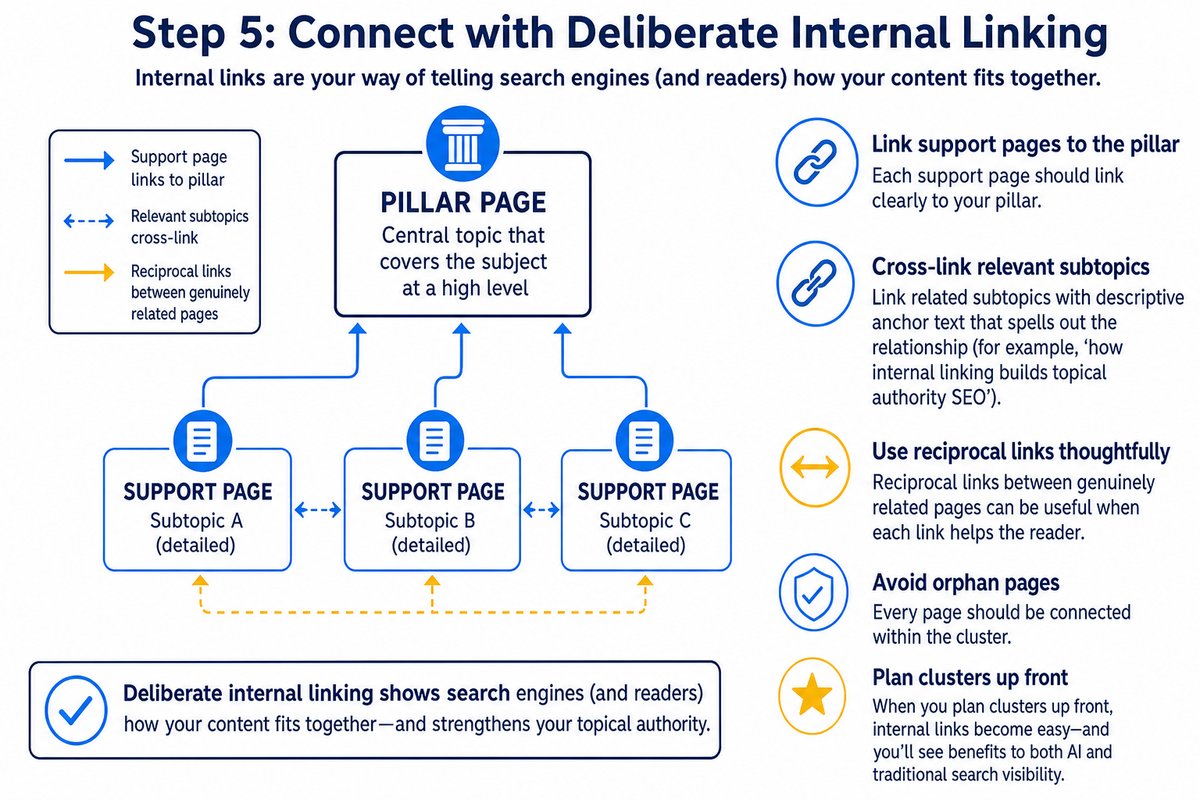
Internal links are your way of telling search engines (and readers) how your content fits together. Each support page should link clearly to your pillar, and relevant subtopics should cross-link with descriptive anchor text that spells out the relationship (for example, 'how internal linking builds topical authority SEO').
Avoid orphan pages. Reciprocal links between genuinely related pages can be useful when each link helps the reader. When you plan clusters up front, internal links become easy—and you’ll see benefits to both AI and traditional search visibility.
Step 6: Complete, Monitor, and Maintain Your Cluster
Don’t rush to new topics when a cluster is only half-built. Finish each topic thoroughly—then use analytics tools to spot gaps and update content as your industry and search trends change. Refresh outdated advice, add new frequently asked questions, and strengthen weak pages over time.
Finally, pursue relevant external links and mentions. These should come from sites that have natural topic overlap, not just high-traffic domains unrelated to your niche. This mix of in-depth coverage, internal structure, and relevant third-party signals cements your topical authority.
Conclusion
Building topical authority for SEO is straightforward, but it requires commitment: map your topic carefully, cover every useful question, link with intention, and show real expertise at every step. When you follow this practical, repeatable model, your site becomes the resource both users and search engines trust for your niche.
Want help mapping, building, or auditing your topical clusters? Request an SEO & AI Visibility Audit from TitanTech360—get a clear, actionable report on where you stand and how to grow your search presence.
Frequently Asked Questions
Is topical authority a real Google ranking factor or score?
Topical authority is not a secret Google metric. It’s a content strategy supported by search engine best practices—there’s no official score, but depth and coverage can improve ranking potential.
How big should my topic cluster be to build authority?
Your cluster should cover your topic thoroughly, but doesn’t need to be massive. Focus on answering every real question your audience has about your main topic before expanding.
What’s the difference between topical authority and just publishing a lot of blogs?
Publishing many disconnected posts is not enough—topical authority means cohesive coverage grouped by topic, with each page supporting the others and clear internal links.
How do I know if my website lacks topical authority?
Thin content or unanswered customer questions can reveal coverage gaps. Weak rankings alone do not diagnose their cause; review relevance, technical accessibility, competition and content quality together.
Why does internal linking matter for topical authority SEO?
Internal linking signals to search engines how your content pieces relate. It helps users and algorithms understand your expertise across an entire topic cluster.
Ready to Put This Into Practice?
Let's talk about where your business stands today and what to fix first.
Book a Call