Key Takeaways
- Use deterministic automation for stable, rule-based tasks with predictable outcomes.
- AI agents handle tasks that require judgment, interpretation, or dealing with unstructured data.
- Human decisions remain vital for high-stakes, sensitive, or error-intolerant scenarios.
- Hybrid solutions often provide the best value, blending reliability and flexibility.
- Overusing AI agents can introduce risk, cost, and unpredictability—match the approach to your workflow's risk and complexity.
Introduction
Choosing between deterministic automation, AI agents, or human-led decisions depends on the complexity, predictability, and business value of each task. Deterministic automation is best for stable, rule-based tasks where the same input should always produce the same result. AI agents make sense for messy, variable situations where context or judgment is needed, such as interpreting customer emails or extracting complex intent. Human decisions still matter most when mistakes are unacceptable or the process is too nuanced for automation. For many businesses, the strongest workflow is a hybrid, combining predictable automation with AI interpretation only where necessary—and keeping humans in the loop whenever risk is significant.
Where Deterministic Automation Delivers Best Results
You should use deterministic automation when your processes rely on structured data, well-defined rules, and need absolute consistency. This includes repeatable tasks where you expect the same output for the same input—think invoice processing, API-driven data syncs, or compliance checks.
In these use cases, deterministic automation is fast, cost-effective, and easy to audit. It rarely fails unless inputs or processes change unexpectedly. For example, standardizing the steps in nightly reconciliations or automating reminder emails for clients ensures reliability without any need for human judgment.
Review our post on Manual vs Automated Business Processes for more on when to stay fully automated.
Want help implementing this in your business?
Book a CallWhen Your Business Needs AI Agents
AI agents are designed for the gray areas—unstructured data, variable language, and decisions that require interpretation rather than a fixed rule. Examples include drafting responses to customer emails where every request is slightly different, or sorting support tickets by intent and urgency.
Because they don't always give the same answer for the same input, AI agents need careful oversight: guardrails, logging, and often a human-in-the-loop for higher-risk actions. Use them where the potential business value of good interpretation outweighs the unpredictability or cost.
If you’re considering integrating AI into complex workflows, see our guide on How to Integrate AI Into Your Workflows.
Hybrid Workflows: The Smart Combination
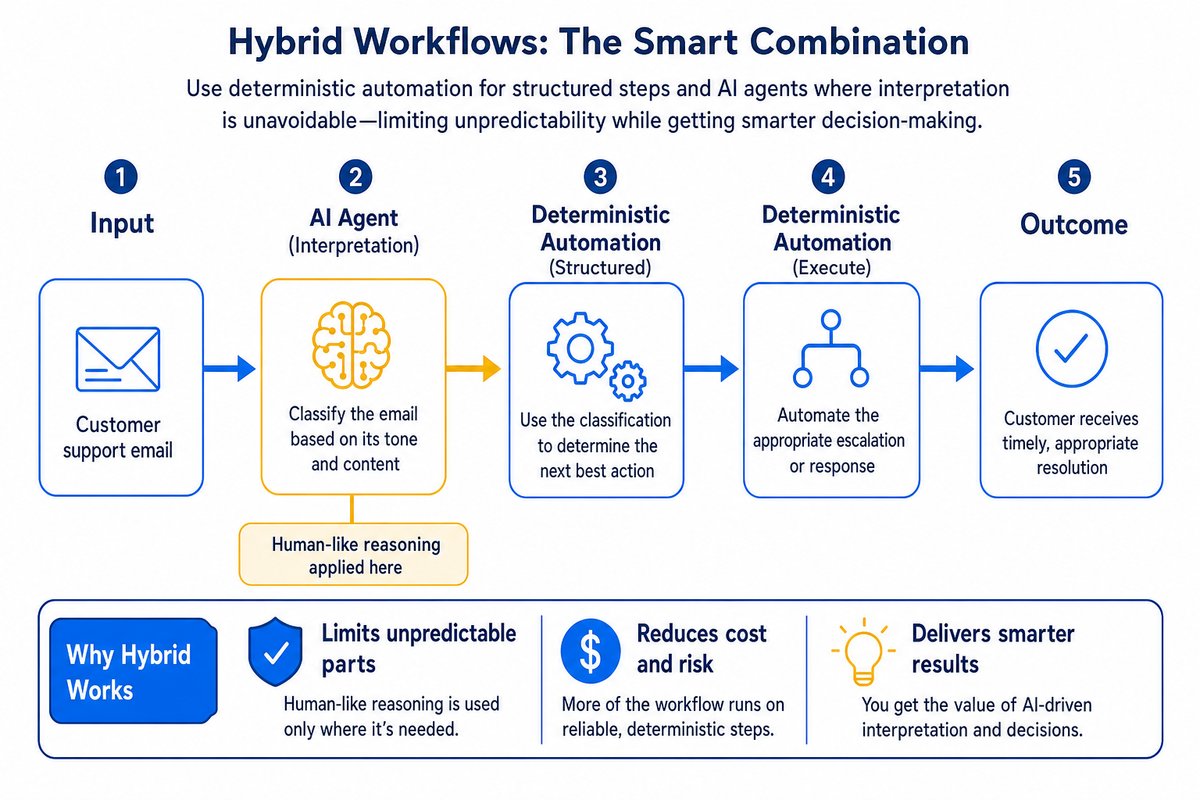
Many of the most successful organizations adopt a hybrid approach, using deterministic automation for structured steps but bringing in AI agents where interpretation is unavoidable. For instance, an AI agent might classify a customer support email based on its tone and content, then deterministic automation handles the appropriate escalation or response.
This limits the unpredictable parts to just the link where human-like reasoning is needed—reducing cost and risk while getting the value of smarter decision-making.
Where Human Oversight Remains Essential
Even with advances in AI integration, there are still decisions best left to people. When errors can cause significant harm, complexity is extreme, or regulatory consequences are serious, human review and sign-off is key. In high-stakes processes, systems often include checkpoints where humans validate the AI or automation’s output before final action.
This approach blends speed and reliability with the judgment only people can bring. You’ll find more about decision checkpoints and risk profiles in The 7 Systems Every Business Needs to Grow.
Avoiding the Pitfalls of Over-Automation
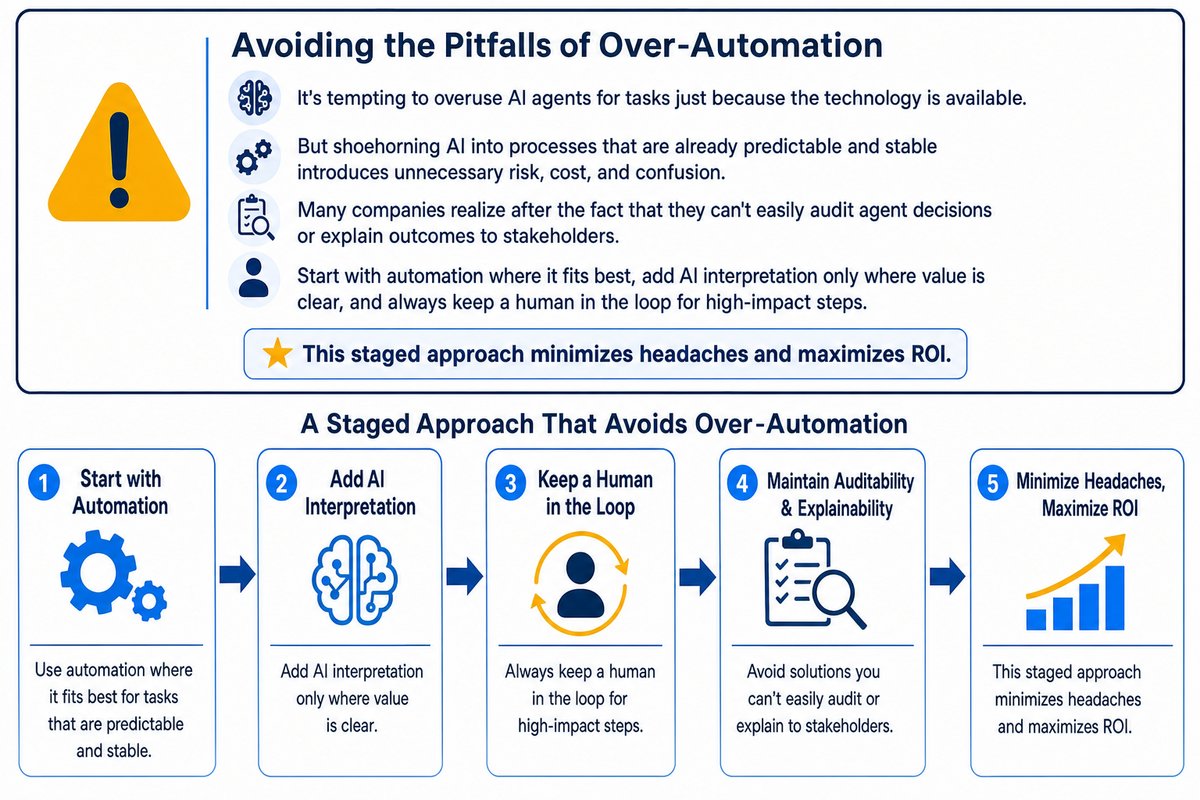
It’s tempting to overuse AI agents for tasks just because the technology is available. But shoehorning AI into processes that are already predictable and stable introduces unnecessary risk, cost, and confusion. Many companies realize after the fact that they can't easily audit agent decisions or explain outcomes to stakeholders.
Start with automation where it fits best, add AI interpretation only where value is clear, and always keep a human in the loop for high-impact steps. This staged approach minimizes headaches and maximizes ROI.
Conclusion
Choosing between deterministic automation, AI agents, or human review comes down to process structure, desired outcome consistency, and the risks of getting it wrong. Stable, rule-based tasks belong to automation; tough, interpretation-heavy issues suit AI agents; and humans should handle anything too sensitive or error-prone to automate.
Map out your key workflows, identify the decision type at each step, and consider a hybrid approach. Need help making the right calls for your team? Start with our AI Integration Guides for Small Business or Book a Call to talk through your workflow challenges.
Frequently Asked Questions
How do I know if a process should use deterministic automation or an AI agent?
Ask if the process has clear, explicit rules for all cases. If so, deterministic automation is usually best. If the task involves complex interpretation or handling of messy, unstructured input, consider using an AI agent—ideally, within guardrails and with oversight.
What is a 'hybrid workflow' in this context?
A hybrid workflow combines both deterministic automation for rule-based steps and AI agents for parts needing interpretation. This keeps your process predictable wherever possible but lets you handle exceptions or complexity with AI.
Are there risks in overusing AI agents?
Yes. Overusing AI agents can create extra cost, unpredictable results, and make auditing harder. Only use agents where they add real business value.
When must a human always make the decision?
Require a human decision when the stakes are high, the process is not well understood, or regulatory consequences are serious. Human oversight is also important for mission-critical outcomes.
Where can I get more help with AI integration?
Read our AI Integration Guides for Small Business or Book a Call for direct support and custom recommendations.
Ready to Put This Into Practice?
Let's talk about where your business stands today and what to fix first.
Book a Call